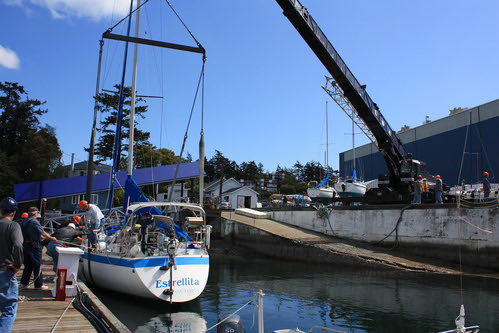
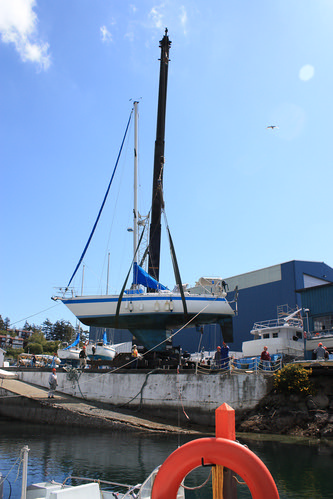
HAUL OUT MONDAY!
The rudder steers the boat. That’s pretty important. You can steer somewhat with sail trim as well but it’s pretty nice to have a rudder.
The rudder integrity is also important because it is one of the big holes in your boat. If the rudder falls off or is severely damaged, you can end up with a crapload of water coming into your boat quickly.
Having no reason to think that anything was wrong with the rudder, we have only done the basic tests one might do with a rudder:
1) Can you steer (move the rudder) without a hernia? This could be binding bushing/bearings or a steering quadrant issue.
2) When you wiggle the rudder by hand is there a lot of play? This would suggest bushing/bearing issues.
3) Assuming you have a cored rudder (we do), do you have evidence of water in the rudder? This might be a lot of blistering (we have only one or two), rust (we have a little), and finally, if you knock on your rudder as soon as it comes out of the water, does it sound hollow? Ours sounds hollow which indicates that the core isn’t full of water.
Our rudder is connected to the boat in 3 places: 1) a delrin (nylon) bushing at the deck level in the back of the cockpit to which we can attach an emergency tiller if our steering wheel breaks, 2) a copper packing gland where it pokes out of the hull into the water (I need to learn about this one – I don’t really understand it yet) and 3) a delrin bushing at the bottom of the skeg* inside a metal shoe which holds the bushing, and thus the rudder, against the skeg.
Carol noticed a bulge of paint on the aft starboard side of the shoe and scraped at it and found…a crack.
Someone had sanded down to the shoe right at this crack and apparently decided it was OK. In their defense, perhaps it was smaller then or perhaps they know more than we do and thought it was fine. We didn’t.
Enter the fantastic old salts at the CFSA. They, along with Ken aboard SV Seeker, a fellow Pretorien owner, really saved the day. Carol and I are pretty handy but we aren’t welders, have never dropped a skeg hung rudder and neither of us have done much hull repair.
We made a panicky call to a welder everyone recommended who is a member and he came by that afternoon. While waiting for him, we put the rudder itself on blocks and with the help of another CFSA member, chiseled off the fairing material covering the shoe (the fairing is only there to blend the shoe into the rest of the skeg for hydrodynamicity and aesthetics).
If you know Carol you will know that this is his “tabernac-en-chris I can’t believe this” smile. Isn't he hot?
We then removed and cleaned the shoe so the welder could repair it.
Here is the skeg and the rudder prior to any additional cleaning. You can see the old sealant. As disgusting as this looks it is actually in good shape. Cleaned up the fiberglass looks solid and the shape is very good.
We could not remove the old delrin bushing without destroying it and during the removal had discovered that there were only 4 bolts despite 5 holes because one of the bolts had been sheared off inside the skeg sometime in the boat’s history and had been cut off and epoxied into place. This was a mixed blessing because it sucks to have anything less than perfect. If the factory put in 5 bolts, shouldn’t we have 5??! But we couldn’t punch the hole through the skeg without potentially cracking it and not using that hole allowed the welder to put a reinforcing plate around the shoe rather than welding the crack for which he would have needed to remove the bushing. The delrin bushing can be replaced but finding exactly what you need can be a tricky business and ours was in perfect condition.
The bolts themselves get bent by the process of tightening down on the curved boot on the curved skeg. Here are what our old ones looked like:
I cleaned the skeg until it was perfect, bought new bolts and hardware and fairing compound and when the welder was finished we snugged on a repaired, bulletproof shoe with the original bushing and some Sikka sealant.
The bolts had to be cut once snugged – Carol is in charge of all things related to cutting metal :) You can’t buy the correct size bolts because they would be too short to get the nuts on originally and then after snugging them they are too long so you have to buy long bolts and then cut them after tightening. After that I used some 3M fairing compound to putty over the metal shoe and fill it out until it had the same shape as the skeg, or as close to that as I could sculpt in the ever vanishing time that we had before splashing.
I didn’t get any pictures of my fairing job pre-bottom paint but here is what it looks like afterwards.
It was heart wrenching, gut turning, shoulder tensing business. There are a few possible causes of the crack. Delrin bushings absorb water and swell. This can cause them to bind on your rudder post making your steering stiff. It could, conceivably, also caused our shoe to crack, particularly if that was where the initial weld was in the circular bushing fitting. Or…someone hit something hard. We know, from the log book, that the PO had a fiberglass place inspect the rudder and “everything was ok”. Did they grind down to inspect the shoe?
We are very, very glad that we found this out now before something bad happened. We also learned a ton about rudders that we didn’t know, and we know that our set up is bullet proof now and we know how to check it every year when we haul out.
*a skeg is a fiberglass protrusion at the back of the boat, in our case molded in as part of the hull casting (it can be bolted on).
The rudder steers the boat. That’s pretty important. You can steer somewhat with sail trim as well but it’s pretty nice to have a rudder.
The rudder integrity is also important because it is one of the big holes in your boat. If the rudder falls off or is severely damaged, you can end up with a crapload of water coming into your boat quickly.
Having no reason to think that anything was wrong with the rudder, we have only done the basic tests one might do with a rudder:
1) Can you steer (move the rudder) without a hernia? This could be binding bushing/bearings or a steering quadrant issue.
2) When you wiggle the rudder by hand is there a lot of play? This would suggest bushing/bearing issues.
3) Assuming you have a cored rudder (we do), do you have evidence of water in the rudder? This might be a lot of blistering (we have only one or two), rust (we have a little), and finally, if you knock on your rudder as soon as it comes out of the water, does it sound hollow? Ours sounds hollow which indicates that the core isn’t full of water.
Our rudder is connected to the boat in 3 places: 1) a delrin (nylon) bushing at the deck level in the back of the cockpit to which we can attach an emergency tiller if our steering wheel breaks, 2) a copper packing gland where it pokes out of the hull into the water (I need to learn about this one – I don’t really understand it yet) and 3) a delrin bushing at the bottom of the skeg* inside a metal shoe which holds the bushing, and thus the rudder, against the skeg.
Carol noticed a bulge of paint on the aft starboard side of the shoe and scraped at it and found…a crack.
Someone had sanded down to the shoe right at this crack and apparently decided it was OK. In their defense, perhaps it was smaller then or perhaps they know more than we do and thought it was fine. We didn’t.
Enter the fantastic old salts at the CFSA. They, along with Ken aboard SV Seeker, a fellow Pretorien owner, really saved the day. Carol and I are pretty handy but we aren’t welders, have never dropped a skeg hung rudder and neither of us have done much hull repair.
We made a panicky call to a welder everyone recommended who is a member and he came by that afternoon. While waiting for him, we put the rudder itself on blocks and with the help of another CFSA member, chiseled off the fairing material covering the shoe (the fairing is only there to blend the shoe into the rest of the skeg for hydrodynamicity and aesthetics).
If you know Carol you will know that this is his “tabernac-en-chris I can’t believe this” smile. Isn't he hot?
We then removed and cleaned the shoe so the welder could repair it.
Here is the skeg and the rudder prior to any additional cleaning. You can see the old sealant. As disgusting as this looks it is actually in good shape. Cleaned up the fiberglass looks solid and the shape is very good.
We could not remove the old delrin bushing without destroying it and during the removal had discovered that there were only 4 bolts despite 5 holes because one of the bolts had been sheared off inside the skeg sometime in the boat’s history and had been cut off and epoxied into place. This was a mixed blessing because it sucks to have anything less than perfect. If the factory put in 5 bolts, shouldn’t we have 5??! But we couldn’t punch the hole through the skeg without potentially cracking it and not using that hole allowed the welder to put a reinforcing plate around the shoe rather than welding the crack for which he would have needed to remove the bushing. The delrin bushing can be replaced but finding exactly what you need can be a tricky business and ours was in perfect condition.
The bolts themselves get bent by the process of tightening down on the curved boot on the curved skeg. Here are what our old ones looked like:
I cleaned the skeg until it was perfect, bought new bolts and hardware and fairing compound and when the welder was finished we snugged on a repaired, bulletproof shoe with the original bushing and some Sikka sealant.
The bolts had to be cut once snugged – Carol is in charge of all things related to cutting metal :) You can’t buy the correct size bolts because they would be too short to get the nuts on originally and then after snugging them they are too long so you have to buy long bolts and then cut them after tightening. After that I used some 3M fairing compound to putty over the metal shoe and fill it out until it had the same shape as the skeg, or as close to that as I could sculpt in the ever vanishing time that we had before splashing.
I didn’t get any pictures of my fairing job pre-bottom paint but here is what it looks like afterwards.
It was heart wrenching, gut turning, shoulder tensing business. There are a few possible causes of the crack. Delrin bushings absorb water and swell. This can cause them to bind on your rudder post making your steering stiff. It could, conceivably, also caused our shoe to crack, particularly if that was where the initial weld was in the circular bushing fitting. Or…someone hit something hard. We know, from the log book, that the PO had a fiberglass place inspect the rudder and “everything was ok”. Did they grind down to inspect the shoe?
We are very, very glad that we found this out now before something bad happened. We also learned a ton about rudders that we didn’t know, and we know that our set up is bullet proof now and we know how to check it every year when we haul out.
*a skeg is a fiberglass protrusion at the back of the boat, in our case molded in as part of the hull casting (it can be bolted on).